Posts

Showing posts with the label goddesses

Beginner Heathen Hacks: Altars

Image
One thing I have noticed is that beginner Heathens often have a vision of how their practice should be based on things they have seen online or in books, but it doesn't match what they are able to do at that moment in time. Instead of problem solving they get stuck and get frustrated. I have a few beginner Heathen hacks that have helped a surprising number of people. Today, I would like to share my hacks for altars. First of all, you don't need the big fancy altar. I know it is shiny, perhaps someday you will get there, but no one starts there. All you really need for an altar is a candle and a cup or bowl to hold a liquid offering. (Some people would argue you don't even need that much, but for the sake of this article we are going with my opinion.) A few other things that might be nice on you altar include: incense and an image or depiction of a deity, or of an ancestor.  Beginner Heathen Problem: I live with people who I am not comfortable knowing about my practice You ...
Holy Cow! Musings on Auðumbla

Image
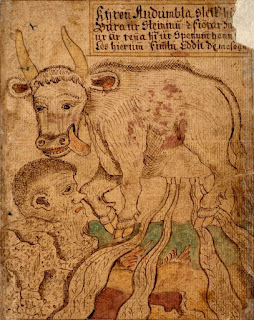
 What do Hinduism and Heathenry have in common? Proto-Indo-European roots and the potential for “Holy Cow” jokes!  One figure in Nordic mythology that I always find fascinating is Auðumbla. Who is this cow, and how did she become a part of the creation story? Is Auðumbla a goddess? Where did she come from? And if she is a cow, why does she have horns? First of all, it seems like there is something funny going on here. Auðumbla is a cow in so far as she is female, but she is no domesticated cow. In fact, she is most likely an auroch, hence the horns. You may have heard of aurochs before if you have done some delving into the runes (or not). Basically, they were wild cattle with huge horns that lived in the forests of Northern Europe. Sadly, they are now extinct.  How did the elder Heathens view aurochs? They associated them with the forests, and wild energy. They also saw them as strong and persevering. So then, it makes sense that Auðumbla, an auroch, was seen as a powerf...

Modern Yule and Solstice Traditions

Image
Historically, Midwinter or Jól would have been celebrated according to the lunisolar calendar, so the date of the Midwinter moon would have been in January. Jól traditions were moved after the introduction of christianity to fall around Christmas, which had been influenced in its date by the solstice practices of other pagan groups. In modern times, many heathens celebrate Midwinter at the solstice. That is not my own tradition, but I do recognize the solstice as an important day in the heathen calendar. To me the Yule month (December) and the Midwinter month (January) are ripe with festivity. The Wild Hunt is shrieking through the night skies, the frost and snow is settling everywhere, and the dark time extends itself over everything. The urge to retreat from the busyness of the rest of the year is strong. It is time to slow down the pace, and enjoy the warmth of hearth and home. Still, the Solstice day is a day to be outside, hailing Sol, knowing the light will be returning.  It ...

What Women Can Learn from Skaði

Image
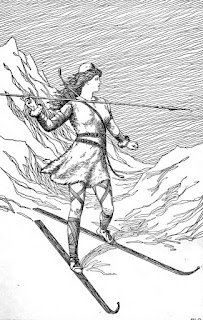
Whenever the icy winds roar across the prairies and the temperatures drop I find myself thinking about Skaði. I imagine her standing out in some field among the snow drifts with snowflakes caught in her hair, laughing as the wind shrieks around her.  Nordic goddesses are all pretty tough, but Skaði is next level. Perhaps it is her Jötunn blood, or perhaps it is how she loves to be out on the land. I spend a lot of my time hiking in all seasons. My body quickly adapts to the temperatures, I know well when the weather will change and I am prepared for it. Many people I know complain when they have to go outside this time of year, but there is a certain satisfaction in victory over the elements, in surviving all of winter’s harshness, not just enjoying its sweetness through the window. The frigid temperatures remind us that it is a gift to be alive every day and that we should make the most of it. Skaði more than beats the elements, she thrives in them. And this is also metaphorically...

The Figure of Holda, Through the Ages

Image
One of the most frequent associations with winter in heathenry is the Wild Hunt. But who is the leader of the Wild Hunt? Could it be Odin, or perhaps a more female host? You may have heard the names Perchta, Hulle, Holda, Berchta, and many other variations. Sometimes she is even called “Frau Gode,” suggesting she is Odin’s wife. Many scholars argue she is an all-mother goddess from the Proto-Indo Europeans.  Holda comes from the Proto-Germanic "hulþaz" meaning "favourable, gracious, or loyal." And if we look at the Grimm’s Fairy Tale “Mother Holle” we see that she rewards those who are humble and loyal, and punishes those who act contrary to these ideals. It seems in particular that she dislikes greedy or lazy people.  Mother Holle is associated with snow. When her quilt is shaken, it snows in the world. And some say Holda is associated with the first snowfall in particular.  But is she a goddess or some sort of spirit who rewards hard work? Holda is associated with...

Sol and Mani, An Argument Regarding Gender in the Lore

Image
Happy Winter Nights, all. I have not been posting much lately, and I am working on some more complex posts that require more time and research, but I am not quite there yet. My day job recently changed and I am still settling into my new role. However, I do have a bunch of other ideas typed up, mostly edited, which I could stick on here whenever. (If I remembered.) The following is one of them. Hopefully, my schedule will even out a bit more soon, and I can spend the necessary time to get more complex content out as well. If you have been following along for awhile you may have a burning question about the deities I choose to examine in this blog. Why am I focusing on male deities so much if this is supposed to be a blog about female perspective? And the answer is (clap with me) I. Don't. Care. For. Your. Judgements.  But more seriously, this blog is a female perspective. As in I am female and I am giving you my perspective. And which deities I choose to talk about come at a whim, ...

Freyja, Fire, Brísingamen, and Other Musings...

Image
(Maybe not appropriate for children under 14, or whatever. That is up to your discretion.) What is Freyja’s association with fire, or does she have one at all? This is what I will (mostly) be exploring today in this blog, but there is a lot about Freyja to unpack, and honestly, it starts with just trying to clear up what exactly she is associated with in a more broad sense. If we let this narrative be told through a christian lens we would probably say that Freyja is the Nordic Aphrodite, the goddess of love (or lust?) and beauty. I take issue with this. At least insofar as that Freyja’s nature is much more complicated than just those elements. It seems like there is a lot of dismissiveness of the importance of goddesses in Nordic mythologies, and I attribute this largely to an attempt at erasure of the power of the feminine by the church. Most goddesses were minimalized, but Freyja, and Frigg, were too big to erase. Instead the tactic was to make Freyja appear as some lustful sorc...